Cia Involvement in Controlling Art Literature Music and Hollywood in the Us and Abroad

Flag of the U.S.A.

Flag of the U.Due south.S.R.
The Cultural Cold War refers to propaganda campaigns waged by both the Usa and the Soviet Union during the Cold War, with each country promoting their ain culture—arts, literature, music—equally well as, less overtly, their opposing political choices and ideologies at the expense of the other. Many of the battles were fought in Europe or in European Universities,[i] with Communist political party leaders depicting the U.s. equally a cultural black hole while pointing to their own cultural heritage as proof that they were the inheritors of the European Enlightenment.[2] The U.S. responded by accusing the Soviets of "disregarding the inherent value of civilisation," and subjugating art to the controlling policies of a totalitarian political system, even as they felt saddled with the responsibleness of preserving and fostering western civilization's all-time cultural traditions, given the many European artists who took refuge in the United states before, during, and after World War 2.[2]
History [edit]
Function of the CIA and the CCF [edit]
In 1950, the Central Intelligence Agency (CIA) surreptitiously created the Congress for Cultural Freedom (CCF) to counter the Cominform'south "peace offensive." At its acme, the Congress had "offices in xxx-v countries, employed dozens of personnel, published over twenty prestige magazines, held art exhibitions, owned a news and features service, organized high-contour international conferences, and rewarded musicians and artists with prizes and public performances."[3] The point of these endeavors was to "showcase" U.S. and European high culture, including non only musical works but paintings, ballets, and other artistic avenues, for the do good of nonaligned foreign intellectuals.[ii]
CCF and the realm of music [edit]
Many U.S. government organizations used American music to persuade audiences worldwide that the U.S. was a cradle for the growth of music.[2] The CIA and, in plough the CCF, were reluctant to patronize America's musical avant-garde, which included artists such experimental musicians as Milton Babbitt and John Cage. The CCF took a more than conservative approach, every bit outlined under its General Secretary, Nicolas Nabokov, and concentrated its efforts on presenting older European works that had been banned or condemned by the Communist Political party.[2]
In 1952, the CCF sponsored the Festival of Twentieth-Century Masterpieces of Modernistic Arts in Paris. Over the adjacent thirty days, the festival hosted ix dissever orchestras which performed works by over 70 composers, many of whom had been dismissed by communist critics as "degenerate" and "sterile," including composers such as Dmitri Shostakovich and Claude Debussy.[ii] The festival opened with a operation of Stravinsky's The Rite of Spring, every bit performed by the Boston Symphony Orchestra.[ii] Thomas Braden, a senior member of the CIA said: "The Boston Symphony Orchestra won more than acclamation for the U.Southward. in Paris than John Foster Dulles or Dwight D. Eisenhower could have brought with a hundred speeches".[2]

The CIA, in particular, used a broad range of musical genres, including Broadway musicals, and fifty-fifty the jazz of Dizzy Gillespie, to convince music enthusiasts across the globe that the U.S. was committed to the musical arts as much equally they were to the literary and visual arts. Under the leadership of Nabokov, the CCF organized impressive musical events that were anti-communist in nature, transporting America'south prime musical talents to Berlin, Paris, and London to provide a steady serial of performances and festivals. In society to promote cooperation between artists and the CCF, and thus extend their ideals, the CCF provided financial aid to artists in demand of monetary assist.[ citation needed ]
Notwithstanding, considering the CCF failed to offer much support for classical music associated with the likes of Bach, Mozart, and Beethoven, information technology was deemed an "authoritarian" tool of Soviet communism and wartime High german and Italian fascism. The CCF also distanced itself from experimental musical advanced artists such as Milton Babbit and John Muzzle, preferring to focus on earlier European works that had been banned or condemned every bit "formalist" past Soviet government.[ citation needed ]

U.S. President John F. Kennedy, Kickoff Lady Jacqueline Kennedy and Soviet First Secretarial assistant Nikita Khrushchev (centre) at dinner in Vienna, in 1961.
CIA and music composition [edit]
The CIA covertly funded the Darmstadt Summer Course, which retaught composers of Abstruse Expressionism, epitomized by the Schoenberg/Berg/Webern school of twelve-tone or scientific "intellectual" music. Initially, the goal was to break down Nazi propaganda such as mail service-Wagnerians as Strauss and Pfitzner that were favored by broad audiences.
Nicolas Nabokov, Secretary Full general of the CCF [edit]

Writer, composer and CCF Secretary General Nicolas Nabokov with his cousin, the writer Vladimir Nabokov in 1950. (Left to right.)
Nicolas Nabokov was a Russian-born composer and writer who developed CCF'due south music program while serving as the organization's Secretary-General. His compositions include several notable musical works, the outset of which was the ballet-oratorio Ode, produced past Serge Diaghilev'due south Ballet Russe de Monte Carlo, in 1928 and Lyrical Symphony in 1931. Nabokov moved to the U.S. in 1933 to serve as a lecturer in music for the Barnes Foundation. A year after moving to the U.Due south., Nabokov composed the ballet Spousal relationship Pacific. He went on to teach music at Wells Higher in New York from 1936 to 1941, and after at St. John'south Higher in Maryland. In 1939, Nabokov officially became a U.S citizen.
In 1945, Nabokov moved to Germany to work for the U.S. Strategic Bombing Survey as a civilian cultural adviser. He returned to the U.S. just ii years after to teach at the Peabody Solarium before becoming the Secretary-General of the newly created CCF in 1951. Nabokov remained in this position for over xv years, spearheading popular music and cultural festivals during his tenure. During this time he also wrote music for the opera Rasputin'southward End in 1958 and was commissioned by the New York City Ballet to compose music for Don Quixote in 1966. When the CCF disbanded in 1967, Nabokov returned to a career in didactics at several universities throughout the U.South., and equanimous music for the opera Honey's Labour'south Lost in 1973.
Festival of Twentieth-Century Masterpieces of Modern Arts [edit]

General Dwight D. Eisenhower in armed services uniform prior to his days as president.
This xxx-day arts festival, held in Paris, was sponsored by the CCF in 1952 in order to change the prototype of the U.S. as having a bleak and empty cultural scene. The CCF nether Nabokov believed that American modernist culture could serve equally an ideological resistance to the Soviet Union. Equally a upshot, the CCF commissioned nine different orchestras to perform concertos, operas, and ballets past over 70 composers who had been labeled by communist commissars as "degenerate" and "sterile." This included compositions by Benjamin Britten, Erik Satie, Arnold Schoenberg, Alban Berg, Pierre Boulez, Gustav Mahler, Paul Hindemith, and Claude Debussy.
The festival opened with a performance of Igor Stravinsky'due south Rite of Spring, conducted past Stravinsky and Pierre Monteux, the original conductor in 1913 when the ballet instigated a riot by the Parisian public. The entire Boston Symphony Orchestra was brought to Paris to perform the overture for the large sum of $160,000. The functioning was so powerful in uniting the public under a common anti-Soviet stance that American journalist Tom Braden remarked that "the Boston Symphony Orchestra won more than acclaim for the U.S. in Paris than John Foster Dulles or Dwight D. Eisenhower could have brought with a hundred speeches." An additional revolutionary functioning at the festival was Virgil Thomson's Four Saints, an opera that contained an all-black cast. This performance was selected to counter European criticisms of the treatment of African Americans living in the U.Due south.
Louis Armstrong and the Cultural Common cold War [edit]
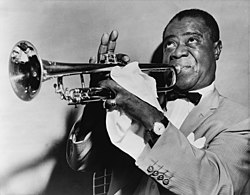
Jazz trumpeter and cultural icon Louis Armstrong in 1953.
During the Common cold War, Louis Armstrong was promoted around the globe as a symbol of U.s. culture, racial progress, and strange policy. It was during the Jim Crow Era that Armstrong was appointed a Goodwill Jazz Ambassador, and his job entailed representing the American government's commitment to accelerate the liberties of African Americans at domicile, while also working to endorse the social freedom of those abroad.
Armstrong's visit to Africa's Gold Coast was hugely successful and attracted magnificent crowds and widespread press coverage. His ring's functioning in Accra resulted in public enthusiasm due to what was deemed an "unbiased support for the African class".
Although Armstrong was indeed advocating the US foreign policy strategies in Africa, he did not whole-heartedly agree with some of the American government's decisions in the South. During the 1957 school desegregation crisis in Little Rock, Arkansas, Armstrong made it a point to openly criticize President Eisenhower and Arkansas Governor Orval Faubus. Instigated by Faubus'due south conclusion to utilise the National Guard to forestall Black students from integrating into Petty Rock High School, Armstrong abandoned his ambassadorship periodically, jeopardizing the US's attempt to use Armstrong to correspond America's racial position away, specifically in the Soviet Matrimony.
It was not until Eisenhower sent federal troops to uphold integration that Armstrong reconsidered and went back to his position with the State Department. Although he had deserted his trip to the Soviet Marriage, he later went on to tour several times for the United states government, including a six-month tour African bout in 1960–1961. It was during this fourth dimension that Armstrong continued to criticize the American government for dragging its feet on the Ceremonious Rights issue, highlighting the contradictory nature of the Goodwill Jazz Ambassadors' mission. Armstrong and Dave and Iona Brubeck (other Ambassadors at the time) asserted that although they represented the American government, they did non represent all of the aforementioned policies.
Ultimately, although America no dubiety benefited from the tours by Black artists (including Duke Ellington and Dizzy Gillespie), these ambassadors did not advocate a singularly American identity. They instead encouraged solidarity amongst Black people, and were constantly contesting those policies that did non fully sympathize with the aims of the civil rights movement.
Meet likewise [edit]
- American National Exhibition
- Herbert Marcuse – OSS amanuensis and revisionist New Left pioneer
- Gloria Steinem – second-wave feminist pioneer
- A Beacon of Hope
- CIA influence on public opinion
References [edit]
- ^ Natalia Tsvetkova. Failure of American and Soviet Cultural Imperialism in High german Universities, 1945–1990. Boston, Leiden: Brill, 2013
- ^ a b c d east f g h Wilford, Hugh. The Mighty Wurlitzer: How the CIA Played America. London, England: Harvard University Printing, 2008.
- ^ Saunders, Frances Stonor (2000). Who Paid the Piper? The CIA and the Cultural Cold War. Granta Books. ISBN978-1862073272.
Further reading [edit]
- Appy, Christian K. Cold War Constructions: The Political Civilization of Us Imperialism, 1945–1966. Culture, Politics, and the Cold War. Amherst: The University of Massachusetts Press, 2000. ISBN 978-1558492189
- Klein, Michael. An American Half-century: Postwar Culture and Politics in the USA. London & Bedrock, Colorado: Pluto Press, 1994. ISBN 978-0745305004
- Rubin, Andrew N. Athenaeum of Authorisation: Empire, Civilisation, and the Cold War. Princeton: Princeton University Press, 2012. ISBN 978-0691154152
- Saunders, Frances Stonor. Introduction to Who Paid the Piper? The CIA and the Cultural Cold War. Granta 1999/2000. ISBN 978-1862073272
Source: https://en.wikipedia.org/wiki/CIA_and_the_Cultural_Cold_War
0 Response to "Cia Involvement in Controlling Art Literature Music and Hollywood in the Us and Abroad"
Post a Comment